If you live with towering conifers, you know our winter wind can be loud, sudden, and relentless. Tree cabling gives those big Douglas-firs and western red cedars quiet backup—discreet support that reduces breakage risk while keeping the tree you love. For many Vancouver WA and Portland-area homeowners, cabling is the difference between sleeping through a storm and watching the forecast with worry.
Why Tree Cabling Matters for Tall Northwest Conifers
In the Pacific Northwest, our signature trees grow fast and tall above shallow, often saturated soils. Broad canopies act like sails in a gale. Add co-dominant stems (those “Y” unions that split high in the crown) or long, heavy leaders over a driveway, and you have a recipe for cracked unions and dropped limbs.
Tree cabling redistributes load across the crown, limiting how far stems can pull apart under wind stress so small flaws don’t turn into big failures.
What is the “Sail Effect”?
Picture an umbrella catching wind. A dense conifer canopy does something similar, especially when needles are wet. Wind pressure moves to the weakest point: a narrow union, a past pruning wound, or a long lever arm over the roof. Cabling adds a hidden belt and suspenders so the tree bends without breaking.
Dynamic vs. Static Cabling: A Quick Guide
Dynamic cabling uses high-strength, flexible rope systems that allow controlled movement. This is often ideal for healthy, younger or mid-aged trees that still gain strength from swaying. Think of it as shock-absorbing support that reduces peak loads while preserving natural motion.
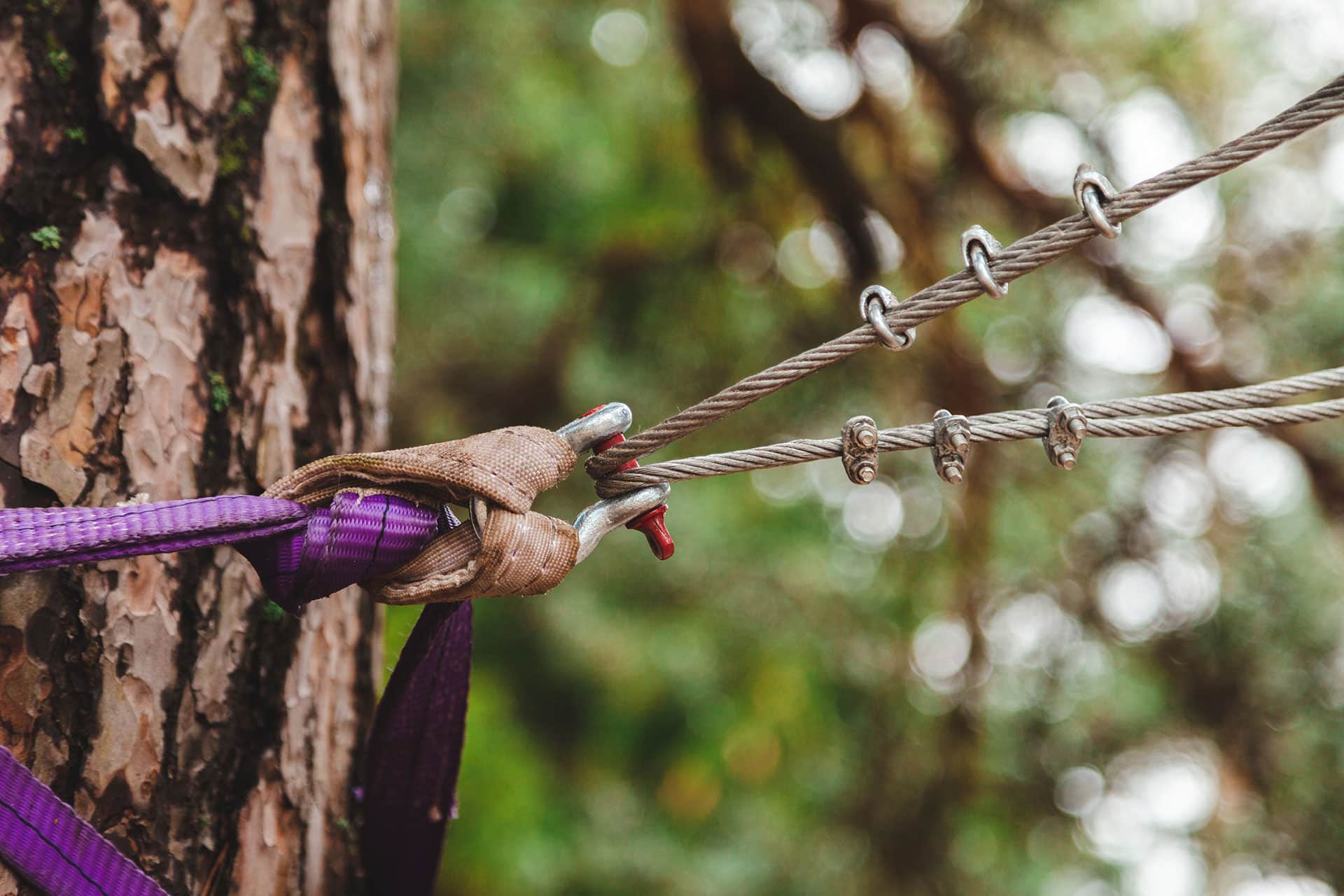
Static cabling uses steel cables and hardware to restrict movement more firmly. It is best when there’s a known defect—like a long-standing crack, a wide V-shaped union, or brittle wood in an aging tree—where extra stiffness prevents further separation.
Which Should You Choose?
- Choose dynamic when the tree is fundamentally sound but wind-prone, and you want to maintain natural biomechanics.
- Choose static when you’re managing a clear structural defect or protecting property targets beneath heavy leaders.
An ISA Certified Arborist can evaluate wood condition, union angles, and target zones to recommend the right approach and proper placement points.
Before-and-After Risk Scenarios You Can Picture
Scenario A: Co-dominant Douglas-fir over a garage
- Before: Two equal stems meet in a narrow V. Each winter, wind rocks them apart. Hairline cracks form where the stems join, and sap bleeding appears after big gusts.
- After cabling and light structural pruning: A static cable near the top union limits separation; selective reduction shortens lever arms over the garage. The tree still moves, but the highest-risk motion is constrained.
Scenario B: Western red cedar over a play area
- Before: Long, sweeping leaders extend over the yard. After a freezing rain, ice loads the tips, turning those leaders into heavy levers.
- After dynamic cabling: Flexible lines share load between leaders, reducing snap risk during gusts or icing. Annual inspection keeps hardware and rope in good shape.
“Call an arborist if…” Checklist
- You see a Y-shaped union with bark included between stems.
- A long leader hangs over a home, driveway, or play set.
- There’s fresh cracking, sap flow, or wood dust near a junction.
- After a storm, branches look newly twisted or out of alignment.
- You notice mushrooms, cavities, or decay pockets near a critical union.
- The tree leans more than it used to, especially after saturated soil events.
- You hear creaking or popping from the canopy in high wind.
When in doubt, a quick assessment by an ISA Certified Arborist can confirm whether tree bracing or cabling will meaningfully reduce risk, or if pruning alone will do.
What to Expect During a Cabling Installation
A professional crew will begin with a safety and structure review, then access the crown using a climber or lift. For dynamic systems, they’ll select anchor branches, install protective sleeves, and tension the rope to the manufacturer’s specs. For static systems, they’ll drill through anchor points, set hardware, and tension the steel line to the prescribed load.
In many cases, light structural pruning happens the same day to reduce leverage on overextended leaders. Most jobs wrap up in a single visit, and the hardware all but disappears into the canopy.
Care After Cabling
- Annual inspection: Trees grow and hardware settles. A quick check confirms tension, anchor health, and rope or cable condition.
- Every 5–10 years: Dynamic lines may be replaced based on manufacturer guidance and site conditions. Static hardware can last longer, but inspections matter.
- Storm follow-ups: After major wind or ice, request a post-event look to catch early issues.
Quick FAQs (Homeowner Edition)
What is tree cabling?
It’s a support system installed high in the canopy to share load between stems and limit damaging movement during wind or ice.
How to cable a tree—can I DIY?
Because placement, tension, and proper hardware matter, cabling is not a DIY project. Incorrect installs can increase failure risk. Always hire an ISA Certified Arborist with cabling experience.
Will cabling damage my tree?
When designed and installed correctly, cabling protects your tree’s structure. Modern systems use protective sleeves and best-practice anchor points to minimize wounding.
Does cabling replace pruning?
No. Cabling works best with thoughtful reduction pruning that shortens heavy lever arms and balances the crown.
Schedule a Tree Cabling Assessment Before the Next Windstorm
If you are wondering, “Do I need cabling for my tall conifers?” let us take a look before the next storm cycle. Tree Contractors NW will review your Douglas-firs and western red cedars, identify windthrow prevention opportunities, and outline a clear plan—tree cabling, tree bracing, pruning, or a mix—to keep your trees strong and your home protected.