If you’re dealing with an overgrown lot, persistent brush, or aggressive blackberry growth, the real challenge is not just trimming it back. It’s choosing the right method for what you want the property to become next. That’s often when an arborist Vancouver WA becomes part of the conversation, especially if you’re working around mature trees, structures, slopes, or tight access. People often use “land clearing,” “brush removal,” and “forestry mulching” as if you’re interchangeable, but they’re not. Each tactic is designed for a different outcome, relies on different equipment, and leaves the site in a different condition.
Once you understand those differences, you can make a smarter decision that aligns with your timeline, your plans, and your budget.
Arborist Vancouver WA Guide: Land Clearing vs. Brush Removal vs. Forestry Mulching
Think of these services as three different levels of intervention. One is about preparing a site for a new use. One is about reclaiming an area that has gotten out of hand. One is about reducing vegetation fast while keeping disturbance low. A qualified arborist Vancouver WA can also help you identify which trees are worth keeping and which ones are risky, especially when you’re working near structures, fences, or slopes.
Below is what each service typically means in the real world, and how to decide when it makes sense for your needs.
What Land Clearing Usually Includes (and What it Leaves Behind)
“Land clearing” is the broadest term. It usually means removing vegetation to change how a space functions. That might be opening up a future building site, creating access for equipment, preparing for grading, or making room for utilities, fencing, or drainage work.
In many cases, land clearing services include more than just cutting down brush. Clearing can involve removing small trees, downed wood, dense vegetation, and sometimes stumps and roots, depending on how finished you need the site to be. If you plan to build, pour gravel, pave, or grade, you typically need more than surface-level cleanup.
Land clearing is the right choice when:
- You need a “blank canvas” for a project like a driveway, pad, fence line, or future construction.
- The area has a mix of brush and woody growth that will keep coming back if you only cut it.
- You need access for other work, like excavation, utilities, or drainage improvements.
A certified arborist Vancouver WA will also flag hazards that affect a clearing plan, like leaning trees, decay, dead tops, or root problems that could fail during or after work begins.
What Brush Removal is Best For (Fast Cleanup Without Major Disruption)
Brush removal is typically more targeted than full land clearing. It focuses on removing overgrowth, vines, invasive plants, tall weeds, and small saplings. The goal is to reclaim usable space without necessarily changing the grade or digging out root systems.
Brush removal can be a perfect fit when the area is messy but you don’t need it “construction ready.” It’s also useful for routine property maintenance, especially in the Pacific Northwest where growth is aggressive and seasonal.
Brush removal is the right choice when:
- You want to clean up a yard edge, trail, fence line, or storm-damaged area.
- You need a safer, more visible property line or access path.
- You want to reduce fire risk or pest habitat, without heavy equipment on the ground.
If you’re unsure whether you’re dealing with brush or small trees that are becoming a real structural issue, an arborist Vancouver WA can help you distinguish between simple clearing and vegetation that needs a more careful procedure.
What Forestry Mulching Does Differently (and Why People Like It)
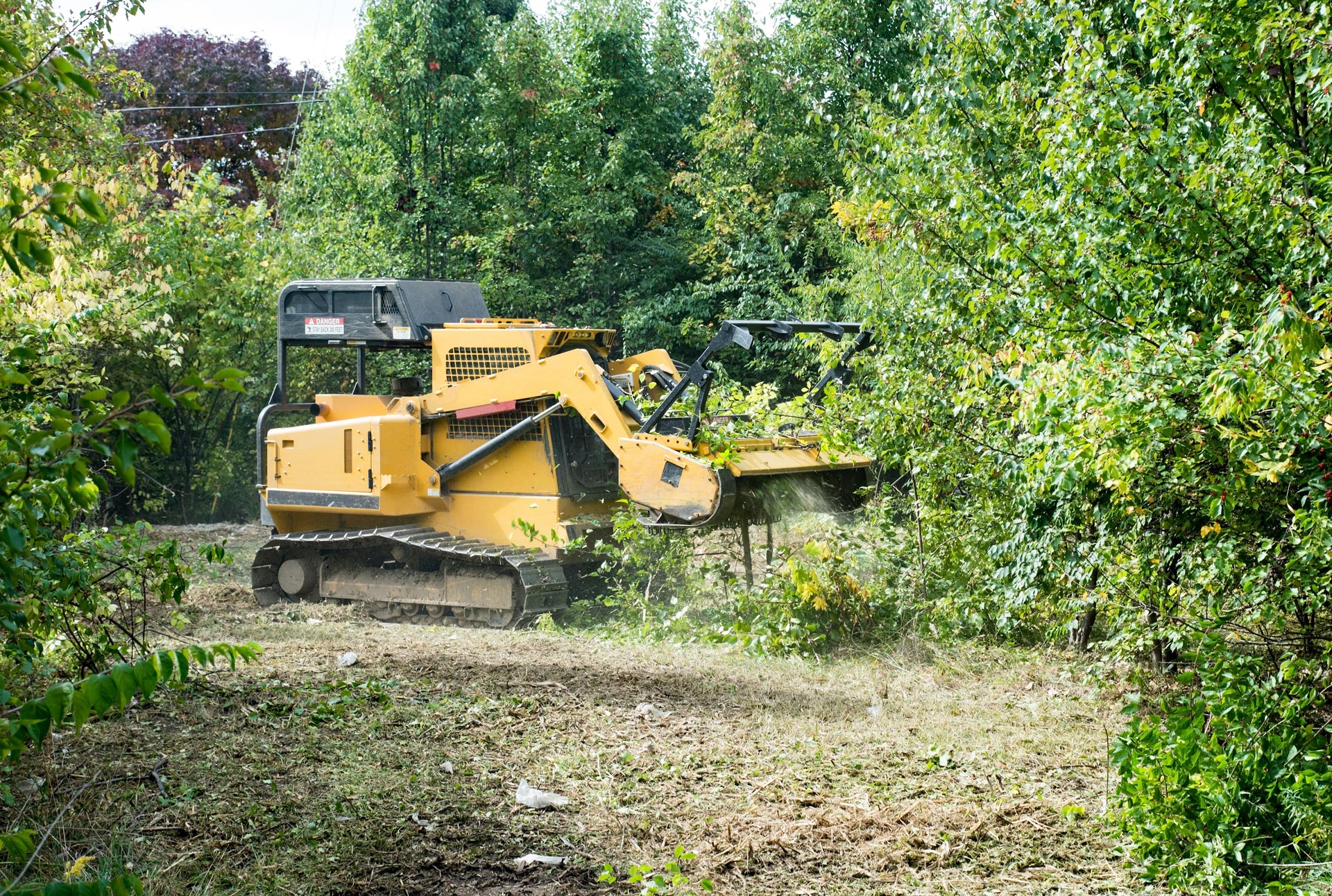
Forestry mulching is a specific method that uses a mulching machine to grind brush, small trees, and vegetation into mulch on site. Instead of hauling everything away, the material is processed and left as a mulch layer on the ground.
That mulch can help suppress regrowth and reduce erosion, depending on the site. It also avoids repeated loading, hauling, and disposal steps, which can be a big advantage when access is tight or disposal is expensive.
Forestry mulching is the right choice when:
- You want fast results with minimal ground disturbance.
- You’re dealing with blackberries, ivy, saplings, and thick brush.
- You want the site to be more walkable and manageable afterward.
- You want to reduce hauling and keep the job efficient.
It’s not always the best choice for every property. If you need a clean surface for construction, or if you need stumps and roots removed, mulching alone might not get you to the finish line. That is where a conversation with an arborist Vancouver WA can help you match the method to the end goal.
How to Decide Which One You Need
When clients feel stuck, it’s usually because you’re asking the wrong question. Instead of, “Which service is cheapest?” ask, “What do I need this area to look like in 30 days and in 12 months?”
Here are the simplest decision cues:
Choose brush removal if:
- You want a cleanup, not a rebuild.
- You’re maintaining space you already use.
- You’re removing vines, weeds, and light growth.
Choose forestry mulching if:
- You want to knock back dense growth quickly.
- You want minimal hauling and a mulch finish.
- You want to manage regrowth without major excavation.
Choose land clearing services if:
- You need a site ready for a new purpose.
- You need access for equipment, grading, utilities, or fencing.
- You expect stumps, roots, or heavier woody growth to be part of the scope.
A few Vancouver, WA realities that can change the plan
In the Vancouver area, soil conditions and slope matter. Wet seasons can make ground access difficult and increase the risk of rutting or compaction. Steeper properties can introduce erosion concerns, especially when vegetation is removed quickly. In some locations, critical areas and buffers can also influence what is appropriate.
That is another reason it helps to talk with an arborist Vancouver WA before you assume the solution is “just clear it.” The right method is the one that solves your problem without creating a new one.
Start With the End Goal: Choosing the Best Clearing Method
Land clearing, brush removal, and forestry mulching are related, but you’re not interchangeable. Brush removal is a focused cleanup. Forestry mulching is a fast, low-haul way to tame overgrowth. Land clearing services are the broader path when you need a site prepared for a new use.
If you start with the end goal, you’ll choose the right method more confidently, and you’ll get results that actually hold up through the next growing season.