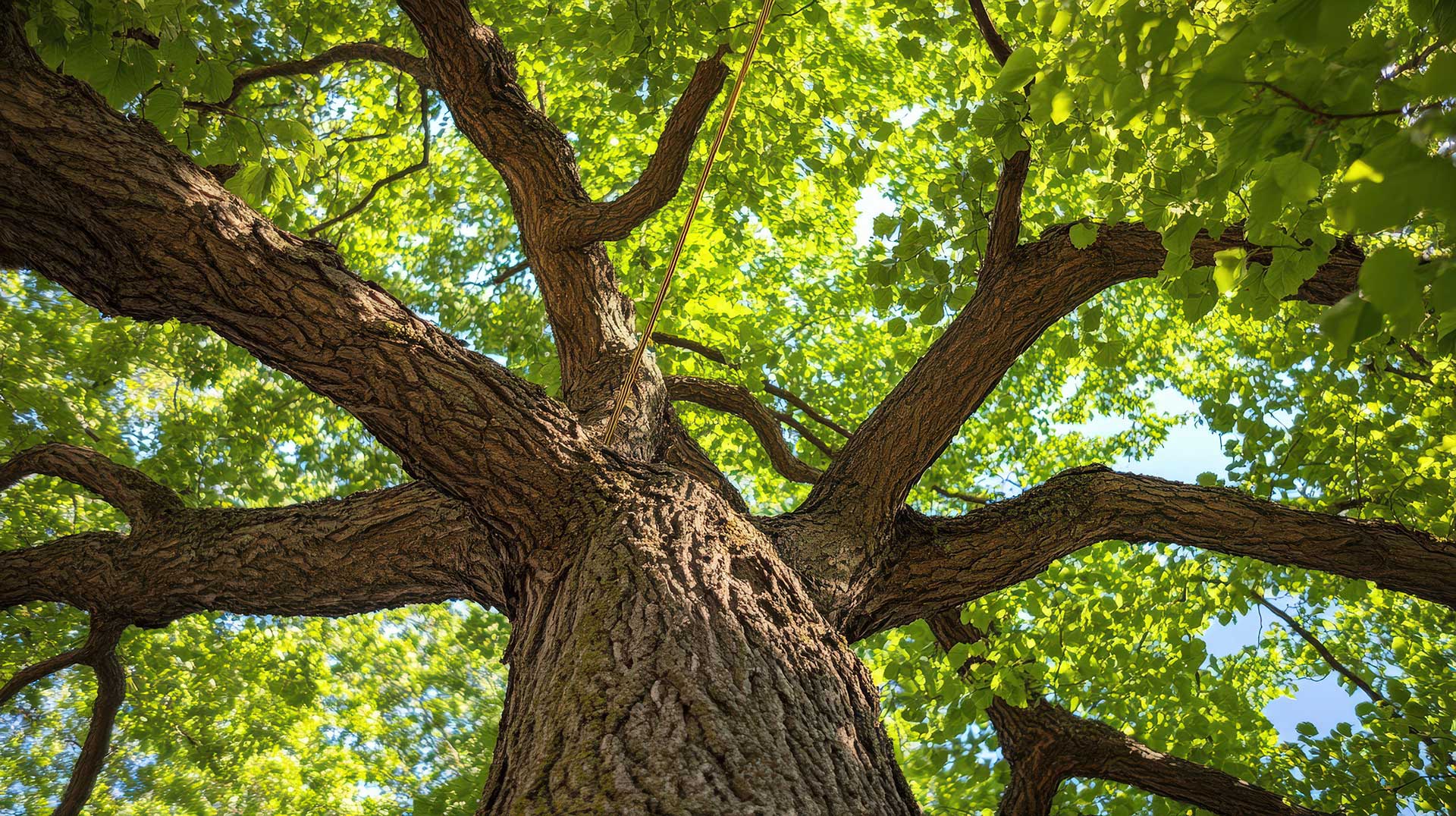
Picture this: You’re looking out into your backyard in Vancouver after a particularly nasty windstorm, and you notice something concerning. That beautiful, twin-stemmed Maple—the one that provides the perfect shade for your summer BBQs—looks like it might be starting to pull apart at the seam.
Your first instinct might be to head to the local hardware store. You figure a heavy-duty chain or some thick steel cable and a couple of bolts ought to do the trick, right? It’s a classic DIY project: see a gap, close the gap.
After all, tree cabling sounds simple enough from the outside: install a cable, reduce movement, and help the tree stay together.
However, tree cabling isn’t a typical weekend DIY project. It involves understanding tree structure, load distribution, decay, hardware placement, pruning needs, and long-term inspection.
When it’s done correctly, cabling may help reduce the risk of certain limbs or stems failing. When it’s done incorrectly, it can damage the tree, put stress in the wrong places, and leave the tree more vulnerable during wind, rain or heavy limb movement.
Here’s what homeowners should know before trying to cable a tree themselves.
What Exactly is Tree Cabling?
Tree cabling is a supplemental support method used to reduce excessive movement in weak branches, codominant stems, or vulnerable unions. It does not “fix” a tree in the way people sometimes imagine. Instead, it helps limit stress on a specific structural weakness.
The International Society of Arboriculture explains that cabling and bracing may be used when branches or trunks need additional support, but the added security is limited and not every weak limb is a good candidate. These systems also need regular inspection after installation.
A cable isn’t a permanent solution. Trees grow, wood expands, canopies shift, storms happen, and hardware can loosen or become embedded into the tree over time. In other words, a support system that made sense five years ago may no longer be appropriate today.
Why DIY Tree Cabling Is Riskier Than It Looks
A tree may look like it only has one obvious problem, but structural defects are often more complicated than they appear from the ground. A heavy limb might be stressed because of decay inside the trunk. A V-shaped union may have included bark, which means the stems aren’t strongly connected. A crack may extend deeper than you can see.
Installing a cable without understanding what those conditions are can make the situation much worse.
One common DIY mistake is placing the cable too low. If the cable is installed at the wrong height, it may not provide proper support where the tree needs it most. A university’s tree care study notes that cables are commonly placed about two-thirds of the way up from a weak union, while bracing is installed closer to or in the union itself.
Another mistake is using the wrong hardware. Ropes, chain, generic bolts, hardware store cable, and improvised straps aren’t the same as a professionally designed tree support system. Some materials can girdle branches, restrict growth, corrode, snap under load, or damage living tissue.
The biggest issue, though, is judgment. Cabling requires knowing whether the tree should be supported, pruned, monitored, or removed. That decision ultimately depends on tree species, defects, decay, targets below the tree, site exposure, and soil conditions.
Cabling Doesn’t Make a Dangerous Tree Safe
While tree cabling reduces certain risks, it doesn’t eliminate them.
If a tree is severely decayed, storm-damaged, uprooting, splitting apart, or leaning toward a home, a cable won’t be enough. In some cases, cabling a compromised tree can delay a more appropriate solution and leave people or property exposed to avoidable risk.
Appropriate tree risk assessment matters before any hardware is installed. If a tree is already actively failing, you may need to call on emergency tree service Vancouver WA for urgent evaluation. Especially true after windstorms, heavy rain, or sudden limb failure, a tree’s condition can change quickly.
A professional can determine whether the tree is a good candidate for cabling or whether a tree removal service Vancouver WA that homeowners trust would be the safer option.
When Tree Cabling Might Be Appropriate
Tree cabling might be worth considering when a tree is otherwise healthy but has a structural concern that could benefit from added support.
Examples may include:
- A mature tree with codominant stems that are beginning to separate.
- A large limb with a weak attachment over a driveway, patio, or walkway.
- A valuable shade tree that has structural risk but still has good vitality.
- A tree that has been pruned to reduce weight but still needs supplemental support.
The key phrase here is “otherwise healthy.” Cabling works best when it supports a tree that still has enough strength, root stability, and living tissue to justify preservation.
Tree support systems are also commonly paired with pruning. Reducing end weight on an overextended limb can lower stress before a cable is installed. Pruning should be considered before installing a support system, since reducing excess limb weight can help lower stress on the tree before cabling is added.
When Cabling Is Probably Not Enough
Not every tree is worth cabling. Sometimes the most responsible answer isn’t the one a homeowner hopes to hear.
Cabling might not be appropriate if the tree has major trunk decay, root plate movement, advanced disease, large cracks, recent storm failure, severe lean, or dead sections in the canopy. It may also be the wrong choice if the tree stands over a home, road, utility line, or regularly used outdoor space and the likelihood of failure is high.
support hardware may complicate the tree’s condition without making it truly safer. A qualified arborist can explain whether mitigation is realistic or whether removal should be considered.
What to Know About Professional Standards
Tree cabling has established professional standards for a reason. The ANSI A300 standards cover supplemental support systems, including cabling, bracing and guying. These standards are intended for professionals and guide how tree support systems should be installed and maintained.
Homeowners don’t need to know every technical detail, but cabling isn’t something to guess your way through. The right system has to match the tree’s structure, the hardware has to be installed in the right place, and the tree still needs to be checked over time as it grows and responds.
A cable needs to be placed deliberately with care. If it’s too tight, it can restrict the tree’s natural movement. If it’s too loose, it may not provide support when the tree needs it most. And if the hardware is installed in the wrong spot, it can injure the tree without actually addressing the weakness. Over time, those details can make a real difference in how the tree holds up.
What You Can Safely Do As A Homeowner
While installing a tree cabling system yourself is usually not the safest choice, you can still keep an eye on the tree and know when something looks off.
Start by checking from the ground. Watch for cracks, splitting branch unions, hanging limbs, mushrooms near the base, sudden leaning, cavities, peeling bark or branches that look like they are starting to pull away from the trunk.
- Keep people and vehicles away from the tree if you notice sudden changes.
- Avoid climbing the tree, drilling into it, tying it off, or cutting large limbs yourself.
- Take clear photos from a safe distance so an arborist can understand what you’re seeing.
- Schedule an inspection before storm season if the tree already has a known weak union or heavy overextended limbs.
These steps help you respond responsibly without creating more risk.
DIY Tree Cabling: Yes or No?
So, can you DIY a tree cabling system?
In most cases, the best answer is no. Tree cabling is specialized work that requires more than hardware and a ladder. It requires a clear understanding of tree biology, structural risk, installation standards, and long-term maintenance.
If your tree has a weak limb or split trunk, the best first step isn’t to install a cable yourself. It should be to find out whether cabling is actually the right solution. Sometimes it is. Sometimes pruning is enough. Sometimes the tree needs monitoring. Sometimes removal is the best decision.
A healthy, mature tree is worth protecting, but protecting it starts with the proper diagnosis. Tree cabling can be valuable when used appropriately. When assumed, improvised, or installed too late, it can do more harm than good.